Water Into Wine: The First Miracle Was a Culinary Act
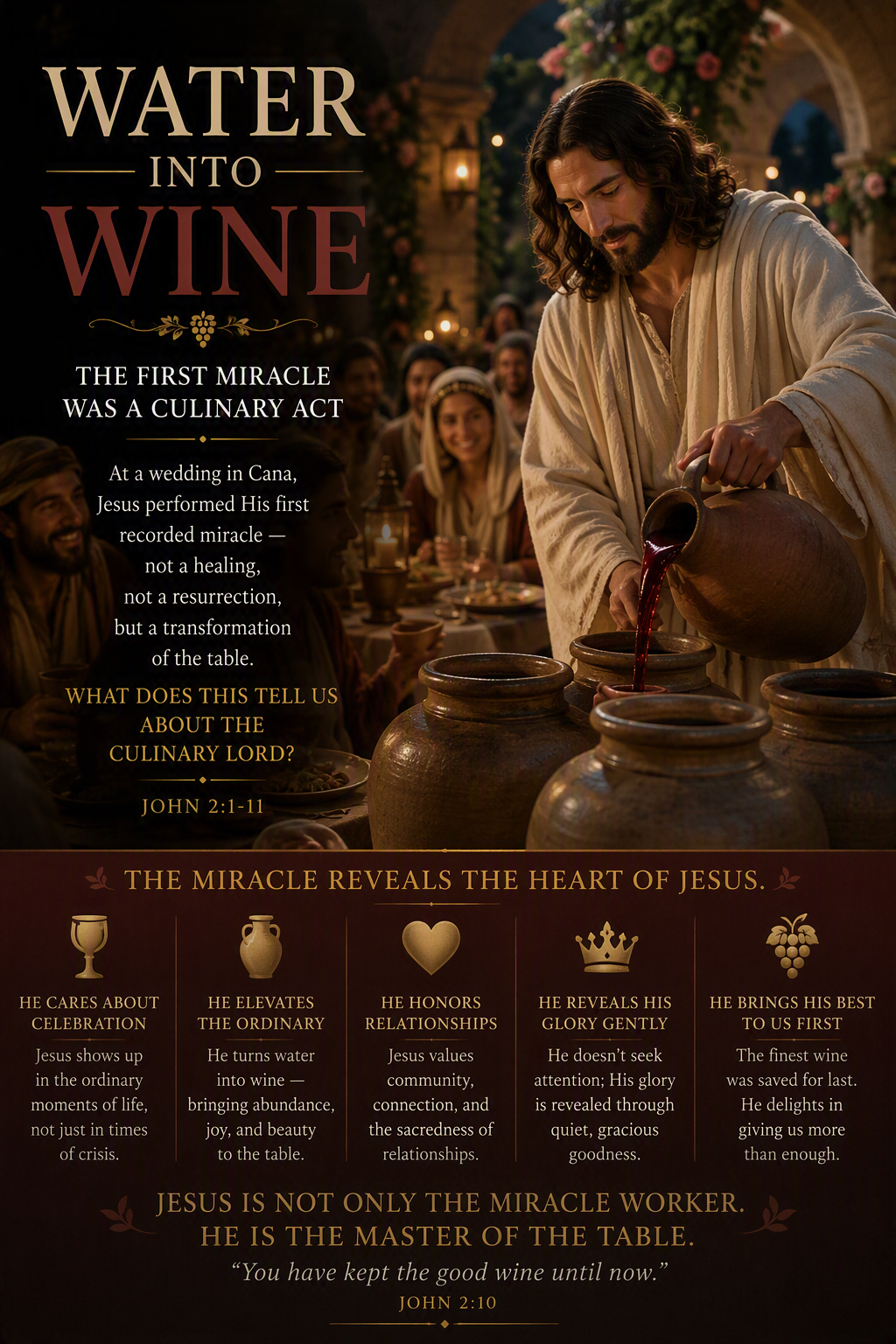
At a wedding in Cana, Jesus performed His first recorded miracle — not a healing, not a resurrection, but a transformation of the table. What does this tell us about the Culinary Lord?
If you were going to design the first miracle of the Son of God — the inaugural sign of His public ministry, the opening act of the most important life ever lived — what would you choose?
A healing? A resurrection? A dramatic display of power over nature?
John tells us that Jesus chose a wedding feast. And at that feast, He chose to make wine.
"What Jesus did here in Cana of Galilee was the first of the signs through which he revealed his glory; and his disciples believed in him." — John 2:11
The first sign. The first revelation of glory. And it happened in a kitchen — or at least, at a table.
The Setting: A Wedding in Cana
Weddings in first-century Jewish culture were not two-hour ceremonies followed by a reception. They were multi-day celebrations — sometimes lasting an entire week — in which the host's honor was bound up in his ability to provide for his guests. To run out of wine at a wedding was not merely an inconvenience. It was a social catastrophe. It was the kind of failure that would be remembered and spoken of for years.
Mary, the mother of Jesus, was at this wedding. She noticed the problem before it became a crisis. And she did what she always did: she brought it to her Son.
"They have no wine." — John 2:3
Four words. No request. No instruction. Just a statement of need, placed before the One she knew could meet it.
The Response: Reluctance and Obedience
What follows is one of the most intriguing exchanges in all of Scripture. Jesus responds to His mother with what sounds, in English, like a rebuke: "Woman, why do you involve me? My hour has not yet come." (John 2:4)
And yet Mary, undeterred, turns to the servants and says: "Do whatever he tells you."
She knew. She had known for thirty years. She had watched Him grow up in Nazareth, had seen the way He moved through the world, had carried in her heart the memory of angels and shepherds and wise men and a star. She knew that when He said "my hour has not yet come," He was not saying "I will not help." He was saying something more profound: "What I am about to do will cost me everything, and this is only the beginning."
And then He helped.
The Transformation: Six Stone Jars
The servants filled six stone water jars — each holding twenty to thirty gallons — to the brim. Then Jesus told them to draw some out and take it to the master of the banquet.
The water had become wine. Not ordinary wine. The master of the banquet, who did not know where it had come from, called the bridegroom aside and said: "Everyone brings out the choice wine first and then the cheaper wine after the guests have had too much to drink; but you have saved the best till now." (John 2:10)
The best wine. Saved for last. Given freely, abundantly, to a party that had already run out.
What This Tells Us About the Culinary Lord
As a culinary specialist, I have spent years thinking about transformation — about what happens when raw ingredients are subjected to heat, time, and skill, and emerge as something entirely new. Fermentation is one of the most profound transformations in the culinary world: the conversion of simple sugars into complex alcohols, the development of depth and character and flavor from something that began as nothing more than juice.
Wine takes time. It requires patience, attention, and the willingness to wait for something better than what you started with.
And Jesus made it in an instant.
This is not merely a display of power. It is a revelation of character. The Culinary Lord is not a God who gives us the minimum required to get by. He is a God who saves the best for last. He is a God who, when He transforms something, transforms it completely — not into something adequate, but into something that makes the master of the banquet stop and wonder where it came from.
The Abundance of the Kingdom
There is a detail in this story that is easy to overlook: the quantity. Six stone jars, each holding twenty to thirty gallons. That is somewhere between 120 and 180 gallons of wine — far more than any wedding party could consume.
This is not efficiency. This is extravagance.
The kingdom of God, as Jesus reveals it at Cana, is not a kingdom of careful rationing and measured provision. It is a kingdom of abundance — of more than enough, of the best wine saved for last, of six jars filled to the brim when one might have been sufficient.
This is the God we serve. This is the Culinary Lord — the One who, when He provides, provides abundantly, and when He transforms, transforms completely.
A Reflection for the Table
The next time you raise a glass of wine — at a wedding, at a dinner table, at the Lord's Supper — remember Cana.
Remember that the first miracle of Jesus was a culinary act. Remember that He chose a table as the setting for His first revelation of glory. Remember that the master of the banquet said, "You have saved the best till now."
And trust that the One who transformed water into wine at a wedding in Galilee is still, even now, in the business of transformation — taking what is ordinary, what is insufficient, what has run out — and making it into something that causes people to stop and wonder where it came from.
The Culinary Lord is still saving the best for last.
Written by
Thomas M. Miller, BSC
Content creator and writer sharing insights and stories.