The Bread of Life: He Did Not Merely Speak of Bread — He Became It
In John 6:35, Jesus makes the most audacious culinary claim in all of history. A devotional reflection on what it means that the Son of God identified Himself as bread.
There is a moment in the sixth chapter of John's Gospel that should stop every person who has ever baked bread, broken bread, or simply eaten bread in hunger.
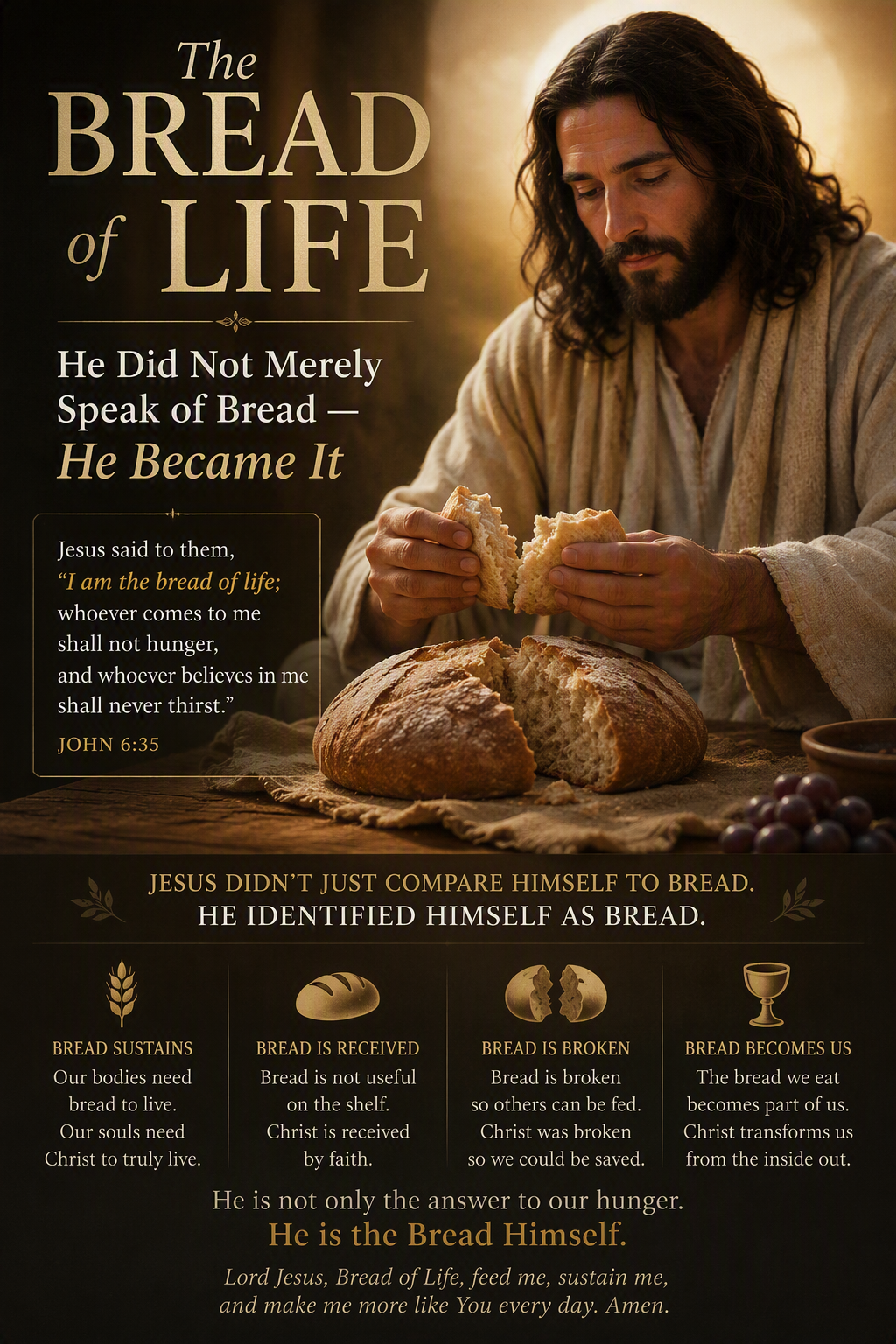
Jesus looks at the crowd that has followed Him across the Sea of Galilee — a crowd that had just witnessed the miraculous feeding of five thousand people with five loaves and two fish — and He says:
"I am the bread of life. Whoever comes to me will never go hungry, and whoever believes in me will never be thirsty." — John 6:35
He did not say, "I will give you bread." He did not say, "I know where the bread is." He said: I am the bread.
The Most Audacious Culinary Claim in History
In the ancient world, bread was not a side dish. It was not an accompaniment to the main course. Bread was the meal. To have bread was to have life. To lack bread was to face death. When the disciples prayed, "Give us this day our daily bread," they were not asking for a dinner roll — they were asking for survival.
And into that world, into that culture where bread meant everything, the Son of God stood up and said: I am that.
As a culinary specialist, I have spent years studying the science and art of bread — the chemistry of fermentation, the theology of the table, the way a simple combination of flour, water, salt, and time can become something that sustains human life. And I can tell you: there is no ingredient more humble, more universal, or more profound than bread.
Which is precisely why Jesus chose it.
Bread Is Made, Not Found
Here is something that every baker knows: bread does not exist in nature. You cannot walk into a forest and pick a loaf off a tree. Bread is made. It requires intention, labor, time, and transformation. Grain must be harvested, ground, mixed, leavened, shaped, and baked. The raw ingredients must be broken down and reconstituted into something entirely new.
This is the theology of the Incarnation in culinary form.
The Son of God did not simply appear on earth as a finished product. He was made — born of a woman, shaped by a culture, formed through decades of ordinary life in Nazareth. He learned to eat. He learned to hunger. He sat at tables, attended weddings, shared meals with sinners and saints. He was, in every sense, made for us.
The bread of life was not dropped from heaven fully formed. It was baked in the oven of human history, over thirty-three years, at the cost of everything.
The Eucharistic Table
When Jesus took bread at the Last Supper, broke it, and said "This is my body, given for you," He was not introducing a new metaphor. He was completing one that had been building since the beginning of His ministry — since the feeding of the five thousand, since the Sermon on the Mount, since the first time He called Himself the bread of life.
The Eucharist is not a symbol of something absent. It is a participation in something present. When we gather at the table, break bread, and remember Him, we are not merely recalling a historical event. We are encountering the Culinary Lord — the One who is, even now, the bread that sustains every soul that comes to Him in hunger.
What This Means for the Culinary Life
For those of us who work with food — who spend our days in kitchens, at markets, at tables — the declaration of John 6:35 is not merely theological. It is vocational.
If Jesus is the bread of life, then every loaf of bread we bake is a small icon of Him. Every meal we prepare for another person is a participation in His provision. Every table we set is a reflection of the eternal table He is preparing for His people.
This does not make cooking a religious ritual. It makes it something better: a daily act of worship, a constant reminder that the One who feeds the world has not forgotten us, and that every hunger — physical and spiritual — finds its answer in Him.
A Reflection for the Table
The next time you sit down to eat bread — whether it is a crusty sourdough, a soft dinner roll, or a simple slice of toast — pause for a moment before you eat it.
Remember that bread is made, not found. Remember that it requires transformation. Remember that it was chosen, of all the foods in the world, by the Son of God to represent Himself.
And then eat it with gratitude, knowing that the One who called Himself the bread of life is the same One who will one day host you at His eternal table, where hunger is no more.
"I am the bread of life. Whoever comes to me will never go hungry." — John 6:35
He meant it. He still means it. And He is still, at this very moment, the bread that satisfies.
Written by
Thomas M. Miller, BSC
Content creator and writer sharing insights and stories.