Bread From Heaven: When the Wilderness Became a Dining Room
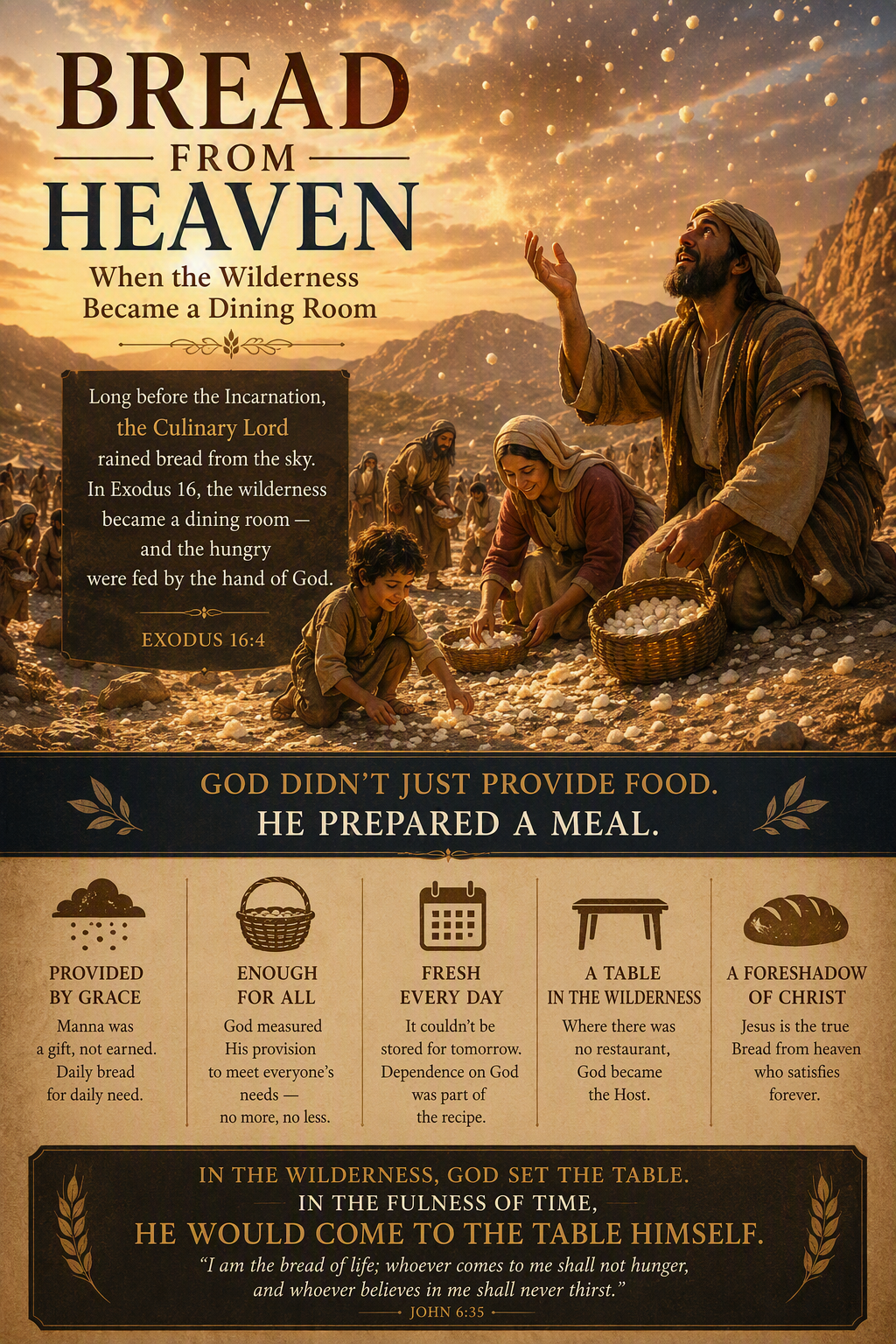
Long before the Incarnation, the Culinary Lord rained bread from the sky. In Exodus 16, the wilderness became a dining room — and the hungry were fed by the hand of God.
There is a place in the Sinai Peninsula where, if you stand in the right spot at the right time of year, you can watch the desert come alive at dawn. The light changes from black to deep violet to gold, and for a few minutes, the wilderness looks almost habitable.
It was in a place like this — dry, barren, impossibly inhospitable — that the people of Israel woke up one morning to find the ground covered with something they had never seen before.
"When the Israelites saw it, they said to each other, 'What is it?' For they did not know what it was. Moses said to them, 'It is the bread the Lord has given you to eat.'" — Exodus 16:15
The word manna comes from the Hebrew man hu — literally, "What is it?" The people named their food after their confusion. And in doing so, they gave us one of the most profound culinary lessons in all of Scripture: sometimes the provision of God looks nothing like what we expected.
The Context: A Hungry People in an Impossible Place
The Israelites had been in the wilderness for six weeks. They had left Egypt with whatever they could carry, and now the food was running out. The complaints were understandable: "If only we had died by the Lord's hand in Egypt! There we sat around pots of meat and ate all the food we wanted, but you have brought us out into this desert to starve this entire assembly to death." (Exodus 16:3)
This is the voice of hunger speaking. It is the voice of people who have traded the known suffering of slavery for the unknown suffering of freedom, and who are beginning to wonder if the trade was worth it.
And God heard them.
The Response: Daily Bread, Literally
What God provided was not a one-time emergency ration. It was a daily provision — six days a week, every week, for forty years. Every morning, the people of Israel woke up to find bread on the ground. Every morning, they gathered what they needed for the day. Every morning, the Culinary Lord set the table in the wilderness.
There are several things about the manna that deserve careful attention.
It was sufficient but not excessive. Each person gathered what they needed — no more, no less. Those who gathered much did not have too much; those who gathered little did not have too little. The provision was calibrated to need, not to greed.
It required daily dependence. The manna could not be stored. Those who tried to keep it overnight found that it bred worms and smelled foul. The only exception was the Sabbath, when a double portion was provided the day before. God was teaching His people something that every chef knows: the freshest ingredients are always the best, and the best meals are the ones that require you to show up every day.
It was mysterious. The people never fully understood what it was. Modern scholars have proposed various natural explanations — secretions from insects, crystallized plant sap — but none of them fully account for the regularity, the quantity, or the supernatural precision of the provision. The manna was, in the end, what it was: the bread the Lord gave them to eat.
The Culinary Theology of the Wilderness
As a culinary specialist, I find the manna story endlessly fascinating — not just theologically, but professionally.
Consider what God was doing in the wilderness. He was not merely feeding a hungry people. He was teaching them a theology of food that would shape their entire relationship with Him for generations to come.
He was teaching them that food is a gift, not an achievement. The manna fell from heaven. The people did not plant it, cultivate it, or earn it. They simply gathered what was given. This is the foundational truth of the culinary life: every ingredient, every harvest, every meal is ultimately a gift from the One who made the earth and everything in it.
He was teaching them that provision requires trust. You cannot stockpile manna. You cannot build a food security strategy around it. You have to wake up every morning and trust that it will be there. This is the daily bread of the Lord's Prayer — not a prayer for a year's supply, but for today's portion, from the hand of a Father who knows what His children need.
He was teaching them that the wilderness is not outside the reach of His table. The most inhospitable place on earth became, for forty years, a place where people were fed. There is no desert so dry, no circumstance so barren, no situation so hopeless that the Culinary Lord cannot set a table there.
The Shadow and the Substance
Jesus knew the manna story. He knew it so well that when the crowd in John 6 challenged Him — "Our ancestors ate the manna in the wilderness; as it is written: 'He gave them bread from heaven to eat'" — He did not dispute it. He fulfilled it.
"Very truly I tell you, it is not Moses who has given you the bread from heaven, but it is my Father who gives you the true bread from heaven. For the bread of God is the bread that comes down from heaven and gives life to the world." — John 6:32–33
The manna was real. It fed real people in a real wilderness. But it was also a shadow — a preview, a foretaste, a culinary prophecy of the One who would come as the true bread from heaven, the One who would not merely feed the body for a day but nourish the soul for eternity.
The Culinary Lord who rained manna in the Sinai is the same One who said, "I am the bread of life." The provision has always come from the same source. The table has always been set by the same hand.
A Reflection for the Table
The next time you find yourself in a wilderness — a season of scarcity, uncertainty, or hunger of any kind — remember Exodus 16.
Remember that the people of Israel woke up every morning in the desert and found bread on the ground. Remember that they named it "What is it?" because it looked nothing like what they expected. Remember that it was sufficient, that it was fresh, and that it came from the hand of God.
And look for the manna in your own wilderness. It may not look like what you expected. It may be small, and white, and strange. But it will be there.
The Culinary Lord has never stopped feeding His people in impossible places. He is not about to start now.
"Then the Lord said to Moses, 'I will rain down bread from heaven for you.'" — Exodus 16:4
He said it. He did it. And He is still doing it — every morning, in every wilderness, for every hungry soul that looks to Him.
Written by
Thomas M. Miller, BSC
Content creator and writer sharing insights and stories.